Home → Bhutan → Bhutan Tour → 7 Nights & 8 Days Bhutan Trip →
7 Nights & 8 Days Bhutan Trip
lets Know About 7 Nights & 8 Days Bhutan Trip
Bhutan is a wonderful Kingdom of Bhutan that appears to be a land that time
has overlooked. Druk Yul, The Land
of Thunder Dragon, encompassed by unblemished regular habitat and amazing
wonderful qualities, It is a realm energetic
with rich social legacy and customs. The land which is secured
by verdant timberland, lavish green valleys, shining streams, superb
mountains secured with enduring day off.
Another best package as we Expert Family will provide is Bhutan 7 night and
8 day program a daring excursion which
covers a large portion of the best pieces of Bhutan and it will be your
acceptable significant outing covers the two
significant urban areas of Bhutan - Paro and Thimpu, Trongsa, Bumpthan and
Punakha. Assuming it doesn't rain, get a
chance to drive west through Dochu La Pass (3,080 m) to have an awesome
perspective on Himalaya above (7000m) height.
Throughout Bhutan visit, get incalculable chance to encounter the interest
of unadulterated
and colorful tourist spots, antiquated fortifications, religious
communities, developed knolls and social villas.
Day 01 : Arrive In Paro Airport (BHUTAN) (B,L,D)
Arrive at Paro Airport and then drive to the capital city Thimphu.
Altitude: 2320m/ 7656ft above sea level.(1 hour 30 minutes drive).
The flight into the Himalayas reveals scenic and breathtaking views of
Himalayan Mountains of the world. If weather permits you will
be able to see Mt Everest (8848m, 29,198ft) and other Himalayan mountain
ranges. After checking into the hotel later visit,
Your representative from the agency will greet you on arrival and drive
you to the capital city, Thimphu.
Tag Dzong: This means - watch tower, which it served as during
the 17th century to guard the region from the Tibetan invasion.
It was converted to the National Museum in 1968. It houses a fine
collection of Bhutanese art, relics, religious thankas
(used to bolster the visualization generated during meditation and were
made from Himalayan animal fibers),
paintings, animals found in Bhutan, arms and ammunitions and the
country’s exquisite stamp collections.
Tashichho Dzong : The names means - Means Fortress of Glorious
Religion. It was built in 1641 by Zhabdrung Ngawang Namgyel.
It houses the secretariat building, the throne room and the office of
the king, and the central monk body..
Later relax for the day and stroll around the city Overnight in Thimphu.
Day 02 : In Thimphu
Morning visit the Memorial Chorten: This particular chorten was
constructed in 1974 as a memorial for the third King of the country,
King Jigme Dorji Wangchuck, who is widely regarded as the father of
modern Bhutan.
Visit Changgangkha lhakhang and later Visit Zilukha nunnery in
Drubthob Goemba: Thimphu is biggest nunnery in Bhutan.
The Nunnery and Goemba once it belonged to the Drubthob (Realized one)
Thang Thong Gyalpo often referred to as The King of the open field.
In the early 15th century with his multiple talents he popularly became
the Leonardo da Vinci of the Great Himalayas.
Simtokha Dzong: Zhabdrung Ngawang Namgyal was one of the greatest
builders of Dzongs in Bhutan and to consolidate his newly acquired
domain in western Bhutan and to defend himself from both the internal
foes and external enemies started the constructions of six Dzongs.
The first Dzong that he undertook to construct was the Simtokha Dzong.
The location has a great historical significance. The present
place where the Dzong stands was the crossroads of the three prominent
western regions of Sha (Wangduephodrang), Wang (Thimphu)
and Pa (Paro). The Dzong was successfully completed in 1631
corresponding to the Iron Sheep Year of the Bhutanese calendar
after two years. The Dzong was named as “Sanga Zabdhoen Phodrang”
(Palace of the Profound Meaning of Secret Mantras).
Later Visit the weekend market in Thimphu: Held every Friday,
Saturday and Sunday, the people crowd the stalls every day,
dressed in full colour and gathered to meet and to barter, much like the
street markets in London!
Overnight in Thimphu.
Day 03 : Thimphu To Gangtey
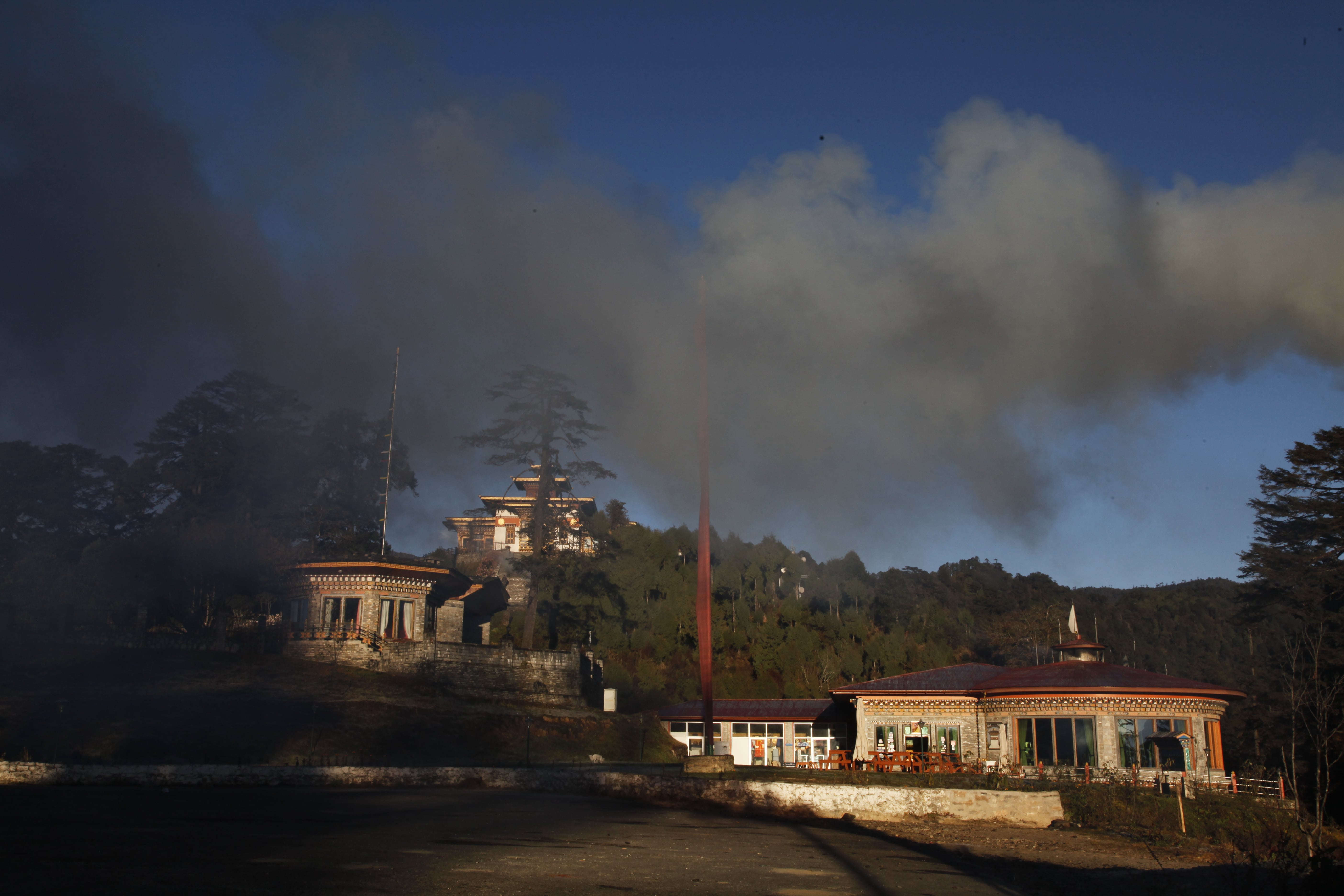
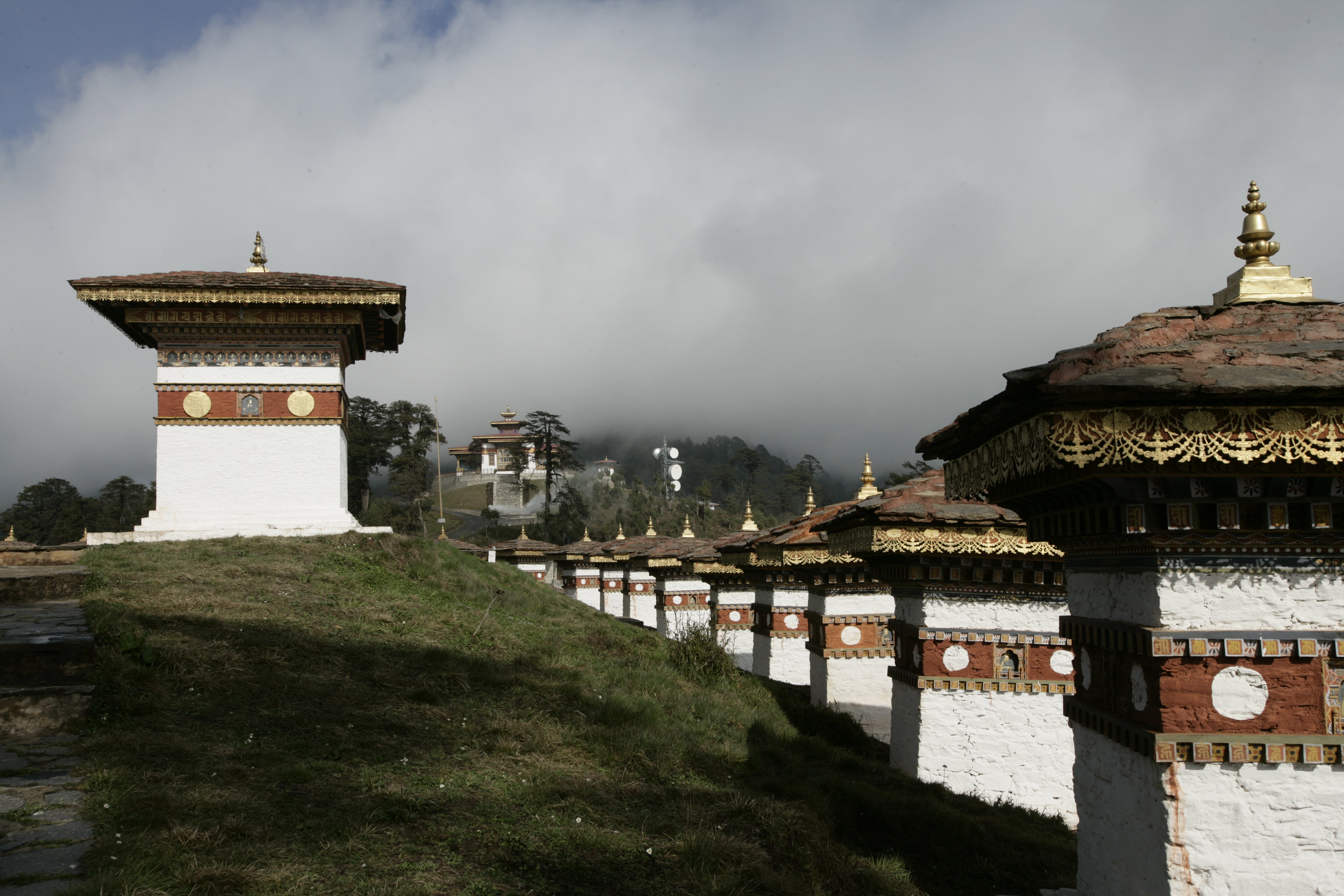
Morning driving towards Gangtey, we come across a pass known as
Dochula (3140m, 10362ft) from where a beautiful panoramic
view of the Himalayan mountain range can be seen, especially in clear
winter days. The beauty of this place is further
enhanced by the Druk Wangyal Chortens- a 108 stupas built by the eldest
Queen, Her Majesty Ashi Dorji Wangmo Wangchuck.
In the mountains east of Wangdue Phodrang lies the beautiful Phobjikha
valley, on the slopes of which is situated the
great monastery of Gangtey, established in the 17th century. The
village of Phobjikha lies a few km. down from the monastery,
on the valley floor. This quiet, remote valley is the winter home of
black necked cranes, which migrate from the arid plains
of Tibet in the north, to pass the winter months in a milder climate.
Overnight in Gangtey.
Day 04 : Gantey To Trongsa
Altitude: 2200m/ 7260ft above sea level. (5 hours drive)
Morning you will hike across Gangtey Nature Trail: (Duration:
Half day: two hours at a quicker pace):
This is one of the most beautiful and shortest of the existing nature
trail. In this trail you have the opportunity
to visit the magnificent Goemba(Monastery), it also leads to sloping
area of green grass, flanked by pine trees on either
side. You will even come across some villages, rivers, crane roosting
ground.
Trongsa Museum: Situated strategically above the Trongsa dzong, the Ta
Dzong served as the watch tower for centuries.
It was built by Choeje Minjur Tempa in 1652.The museum is equipped with
state of the art technology and includes a media
room where visitors can watch a documentary programme on the history of
the monarchy.The Ta Dzong was renovated and
converted as a museum at a cost of Nu. 97 millions with funds from the
Austrian government. The museum is dedicated
to the coronation and centenary celebrations.
Overnight in Trongsa.
Day 05 : Trongsa To Punakha
Altitude: 1350m/ 4455ft above sea level. (6 hours drive)
Morning drive to Punakha visit Punakha Dzong (fortress): Built in
1637 by Zhabdrung which is remarkably located between the rivers
of Mo (Female) Chu (river) and Pho (Male) Chu. Until the time of second
king it served as a seat of the king.
Hike to Chimi Lhakhang(Temple of fertility): This Temple was
built by lam Drukpa Kuenley (The Divine Madman) in 1499. It is about
thirty minutes hike across fields from the road –Wooden phalluses are
often found hanging in the four corners of the houses and
also phalluses are painted on the walls of houses. It is the common
belief that this helps in driving
away evil spirits.(30 minutes hike to and fro, gentle steep, good footh
path across the valleys and villages)
Overnight in Punakha/Wangdue.
Day 06 : Punakha / Wangdue To Paro
Altitude: 2280m/7524ft above sea level. (4 hours drive)
Morning drive to Paro and visit, Rimpung Dzong: The Bhutanese
Dzongs are huge architectural structures constructed
for a variety of functions throughout the country, from administrative
buildings to monasteries and temples, yet they are
carefully and thoughtfully designed and are strikingly beautiful. The
Rimpung Dzong, known as the “fortress of the heap
of jewels” in the picturesque setting of the Paro valley, is of course
no exception, built in the time of the dynamic
spiritual and political leader Zhabdrung in 1644. Once a year, as part
of
the Tsechu festival, one of the oldest Thongdol (gigantic scroll
paintings) is ceremonially unfurled here.
Kichu Lhakhang(Monastery): It is one of the two most sacred and
the oldest temples in Bhutan.
It was built in 7th century by Tibetan King Songtsen Gampo.
Drugyel dzong: This ruined dzong is of historical importance. It
was built in 1649 by Zhabdrung to commemorate
the victory of the Drukpas over the Tibetan invasion in 1644. The
Bhutanese still vividly recall and celebrate
this victory which was tremendously important to the history of the
area. On a clear day
(7326m/ 24176ft), you have a fascinating view of the white domed peak of
sacred Jhomolhari (Mountain of Goddess).
Overnight in Paro.
Day 07 : In Paro
Morning hike to Taktshang Monastery (Tiger’s nest): This is
Bhutan’s most recognizable cultural icon perched 800m/2640ft up a
seemingly sheer cliff. Although it was tragically and mysteriously
consumed by fire in April 1998 it has now been restored to
its former glory. It is believed that in the 8th century, the great
tantric master Guru Rimopche/ Padmasambhava (2nd Buddha)
flew on the back of a tigress to the site where the monastery now
stands. (Five hours hike to and fro, some gentle and some steep hike,
some stony foot path and some good ones) If you ride a horse upward it
will cost extra US$25 per person.
Visit Farmhouse: Picturesque farm houses dot the valley amongst
fields and hillsides. We welcome you to enjoy the hospitality of
the Paro farmers. Thrill yourself as the farmers welcome you to their
homes with genuine smiles. The two to three-storied
Bhutanese farm houses are handsome in appearance, with colorfully
decorated outer walls and lintels, and are traditionally
built. A visit to a farm house gives an interesting glimpse
into the lifestyle of a farming family. (If you take hot stone bath in
the farm house it will cost extra US$25 per person.)
Later stroll around the town and see how locals live.
Overnight in Paro.
Day 08 : Depart From Paro
Early breakfast at the hotel and then drive to the airport. Your escort will assist you with exit formalities and bid you farewell.
COST INCLUDES:-
1. Private transportation2. All necessary travel permits
3. English speaking local guide
4. Accommodation on Single / twin room basis
5. Sightseeing and monastery entrance fees as per the itinerary
6. Meal plan: Full Board Basis
COST EXCLUDES:-
1. Insurance of any kind
2. Additional cost due to natural calamity and unforeseen circumstance
3. Personal Expenses Such As Drink, Tips etc
Company & Services :
Subscribe
Be the first to know about the new trip.